Skip to content
    HAQQ Legal AI Platform Logo
    • HAQQ pour Entreprise
    • Tarifs
    Se connecterS'inscrire gratuitement
    S'inscrire gratuitementRéserver une démo
    1. Accueil
    2. Blog
    3. Les avocats peuvent-ils utiliser l'IA ? Un tracker pays par pays (2026)
    Retour au BlogIA & Tech Juridique

    Les avocats peuvent-ils utiliser l'IA ? Un tracker pays par pays (2026)

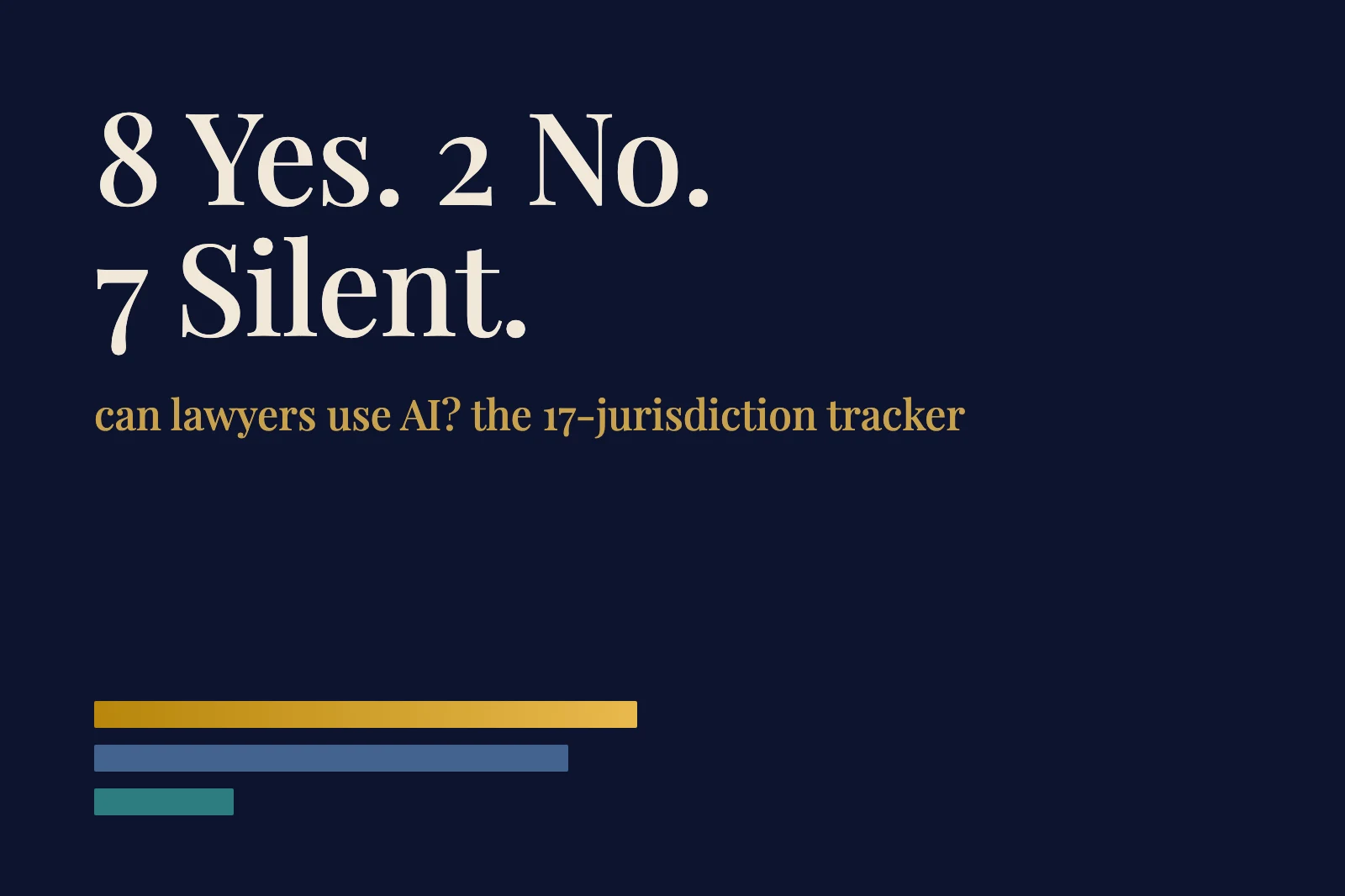
    Oui - sur la plupart des grands marchés, avec des obligations à la clé. 17 juridictions suivies : 8 autorisent avec des lignes directrices, 2 restreignent (UE, Qatar), 7 restent muettes.

    22 mai 2026
    11 min de lecture
    |
    HAQQ Team
    Les avocats peuvent-ils utiliser l'IA ? Un tracker pays par pays (2026)

    TL;DR — Yes, in most major markets lawyers can use AI, but with duties of competence, confidentiality, and verification attached. Across 17 jurisdictions: 8 permit with formal guidance, 2 restrict or require disclosure (EU, Qatar), 7 have not formally addressed it. Most of MENA is in the silent third group — and early, responsible adopters will define the norm.

    The Short Answer

    Can a lawyer use AI? In almost every major legal market, yes — provided they treat the output as a draft, not an oracle. The recurring theme across every regulator that has spoken is the same: AI does not dilute a lawyer's existing duties. You still owe the client competence, confidentiality, and a duty to verify. The tool changes; the responsibility does not.

    Key facts

    • Across 17 jurisdictions tracked: 8 permit lawyer AI use with formal guidance, 2 restrict or require disclosure (EU, Qatar), 7 have not addressed it.
    • Qatar's QICDRC Practice Direction No. 1 of 2026 is MENA's first hard rule: AI-generated content must be flagged and verifiable on affidavit.

    The American Bar Association set the template with Formal Opinion 512 in 2024: understand the tool's limits, protect client confidences, verify the output, and bill reasonably. Most other regulators that followed echo it. The interesting story is not the consensus — it is the map of where regulators have said nothing at all.

    The Tracker: 17 Jurisdictions

    We ran live searches across 17 jurisdictions and classified each as permitted with guidance, restricted or disclosure-required, or not yet formally addressed. Every classification traces to a regulator instrument or its documented absence.

    JurisdictionStatusInstrument
    United StatesPermittedABA Formal Opinion 512 (2024) + state bar opinions
    United KingdomPermittedLaw Society + Bar Council guidance (2025–26)
    European UnionRestrictedAI Act — legal use is high-risk (Aug 2026)
    FrancePermittedCNB déontologie guide (Mar 2026)
    GermanyPermittedBRAK Leitfaden on AI in law firms (Dec 2024)
    CanadaPermittedLaw Societies of AB / ON / BC (2024–26)
    AustraliaPermittedLaw societies + SA & Federal Court rules (2026)
    BrazilPermittedOAB Rec. 001/2024 + CNJ Res. 615/2025
    SingaporePermittedMinLaw GenAI legal-sector guide (Mar 2026)
    IndiaUnaddressedNo BCI rule; Supreme Court notice (Feb 2026)
    QatarRestrictedQICDRC Practice Direction 1/2026 — disclosure
    United Arab EmiratesUnaddressedTDRA AI charter only; no bar rule
    Saudi ArabiaUnaddressedSDAIA guidelines only; no bar rule
    EgyptUnaddressedBar training event (Dec 2025); no rule
    LebanonUnaddressedBeirut Bar AI committee + 2026 MoU; no rule
    JordanUnaddressedTech & data laws only; no bar rule
    MoroccoUnaddressedNo bar or court guidance found

    The tally: 8 permit with guidance, 2 restrict or require disclosure, 7 have not addressed it. Silence is not permission, and it is not prohibition — it is uncertainty the profession has to navigate without a map.

    The MENA Picture

    Is it ethical for lawyers to use ChatGPT? The duty of competence

    The question lawyers actually type into a search bar is narrower than 'can lawyers use AI.' It is 'is it legal for lawyers to use ChatGPT,' and the honest answer is: yes, but the bar moved the goalposts. In the United States, using a general-purpose chatbot is not prohibited. What is prohibited is using one badly. The American Bar Association did not write a new rule for AI; it pointed the existing Model Rules of Professional Conduct at it. ABA Formal Opinion 512, issued July 29, 2024, runs the analysis through Rule 1.1 (competence), Rule 1.6 (confidentiality), Rule 5.3 (supervision of non-lawyer assistance), Rule 3.3 (candor to the tribunal), and the reasonable-fee rules.

    Competence is the one most lawyers underestimate. Opinion 512 says a lawyer must understand a tool's 'benefits and risks' before using it, and it adds a line most people skip: this is not a one-time box to tick. In the ABA's words, 'technological competence presupposes that lawyers remain vigilant about the tools' benefits and risks,' because the tools change underneath you. A lawyer who cannot explain, in plain terms, that a consumer chatbot generates plausible text rather than retrieving verified law is not yet competent to use it on a client matter. That is not our opinion. That is the framing the regulator chose.

    By March 2026, more than 35 US state bar associations had issued their own AI guidance, and they echo the same spine: understand the tool, protect the client, verify the output, bill honestly. The pattern is identical to what every regulator in our tracker above arrived at. The tool is allowed. The duty is non-delegable. You can hand the typing to a model; you cannot hand it the responsibility.

    The confidentiality risk: consumer ChatGPT vs a legal-grade tool

    This is where 'can I use ChatGPT' quietly becomes 'should I.' The single hardest duty for a chatbot to satisfy is Rule 1.6 confidentiality. Opinion 512 is direct about it: because many self-learning AI tools are 'designed so that their output could lead directly or indirectly to the disclosure of information relating to the representation of a client,' a lawyer must get the client's informed consent before inputting that information into such a tool. Not a line buried in an engagement letter. The ABA specifically flags that boilerplate consent 'may not suffice.'

    The reason is architectural, not legal. On consumer ChatGPT (Free and Plus), the default is that OpenAI may retain your prompts and use them to train its models unless you turn that off, and conversations are typically retained for a period regardless of the training toggle. The same is true of consumer-tier Claude and Gemini. Opting out of training does not erase the provider's right to retain data or disclose it in response to legal process. The moment client material lands on that infrastructure, you have arguably shared a privileged communication with a third party who owes your client nothing.

    That risk is not theoretical. In a 2026 Southern District of New York ruling, a federal court held that documents a litigant generated with a consumer-tier AI tool and later shared with counsel were neither privileged nor protected as work product — an AI tool is not an attorney, holds no license, and owes no duty of confidence. We unpack that decision in our piece on why AI conversations are not privileged.

    A legal-grade tool closes the gap by contract and by construction. Enterprise and commercial tiers (ChatGPT Enterprise, Claude's commercial plans) exclude your inputs from training by default and attach contractual confidentiality. Purpose-built legal platforms go further: zero-data-retention agreements with the model providers, deployment inside the privilege rather than outside it, and an audit trail of what the AI did and what a human approved. The distinction that matters is not 'AI vs no AI.' It is 'a tool you can give a confidentiality guarantee on vs a free consumer product where, when the tool is free, your client's data is the product.'

    The clean line: a free consumer chatbot can satisfy your duty of competence with care, but it struggles to satisfy your duty of confidentiality at all — its default terms point your client's data at a third party that owes them nothing. A legal-grade tool is the one that lets you say yes to both duties.

    We tested what this looks like in practice: the same NDA review run on ChatGPT and a purpose-built legal AI, and where generic AI falls short of legal-specific tooling.

    The Gulf, Levant, and North Africa skew heavily toward that silent group — with one sharp exception. Qatar issued the region's first hard rule: the QICDRC Practice Direction No. 1 of 2026 requires lawyers to flag AI-generated content and stand ready to verify it on affidavit. It emerged from an actual case, not a think-tank.

    Elsewhere the groundwork is visible but unfinished. The UAE has a non-binding AI ethics charter; Saudi Arabia has SDAIA guidelines — neither aimed at practising lawyers. The Beirut Bar Association has stood up an AI committee and signed a 2026 government MoU. The Egyptian Bar ran a 'Generative AI for Lawyers' training event in late 2025. Real motion, no binding rule yet. For Morocco and Jordan we found awareness but nothing directed at lawyers.

    For a region HAQQ is built for, that is the whole opportunity: in markets where the norm is not yet codified, the firms that adopt AI responsibly now will set the standard others get measured against.

    Essayer HAQQ AI gratuitement

    Découvrez la rédaction et la recherche juridique par IA

    What It Means

    'Is it allowed?' is the wrong question to stop on. Every regulator that has spoken says the same thing in different words: you may use AI, and you remain fully responsible for the result. So the real question is whether your tools make that responsibility easy to discharge — citations you can check, confidentiality you can guarantee, a record of what the AI did and what a human approved.

    That is the bet we made with HAQQ: build for the duty, not around it. When the Gulf regulators do write their rules — and Qatar shows they will — tools designed for verification and disclosure will already be compliant. The rest will be scrambling.

    Key Takeaways

    • Across 17 jurisdictions: 8 permit with guidance, 2 restrict/disclose, 7 unaddressed.
    • Every regulator agrees AI does not reduce a lawyer's duties.
    • Qatar is MENA's first hard rule; the rest of the Gulf is still silent.
    • Early responsible adoption sets the regional standard.

    Sources & Further Reading

    • 1,458 court cases with AI-fabricated citations
    • the sanctions record: 496 attorneys, $55K in fines
    • our jargon-free LLM guide for lawyers
    • ABA Formal Opinion 512 — generative AI and ethics rules
    • EU AI Act — regulatory framework
    • Qatar QICDRC Practice Direction on AI in proceedings
    • BRAK (Germany) — AI guidance for law firms
    H

    HAQQ Team

    Research

    Ressources associées

    Legal AI ChatEnterpriseSecurity

    Articles associés

    Éthique de l'IA en droit : Avis ABA 512, AI Act européen et obligations des avocats

    Éthique de l'IA en droit : Avis ABA 512, AI Act européen et obligations des avocats

    ChatGPT pour les avocats en 2026 : ses forces et là où l'IA juridique gagne

    ChatGPT pour les avocats en 2026 : ses forces et là où l'IA juridique gagne

    Is It Safe to Use ChatGPT for Your Divorce? What the 2026 Privilege Ruling Changes

    Is It Safe to Use ChatGPT for Your Divorce? What the 2026 Privilege Ruling Changes

    Questions fréquentes

    Can lawyers use AI like ChatGPT for legal work?

    In most major jurisdictions, yes — under existing duties of competence, confidentiality, and verification. Several regulators, such as the ABA's Formal Opinion 512, have issued explicit guidance.

    Do lawyers have to disclose AI use to the court?

    It depends on the jurisdiction. The EU AI Act and Qatar's QICDRC require transparency or disclosure; many courts ask for verification rather than blanket disclosure; most have no rule yet.

    Is it legal for lawyers in the UAE or Saudi Arabia to use AI?

    There is no bar-association rule prohibiting it as of 2026. Both have national AI guidelines, but neither targets practising lawyers, so general professional duties apply.

    Is it ethical for lawyers to use ChatGPT?

    Yes, where you satisfy the existing rules of professional conduct. ABA Formal Opinion 512 (July 2024) runs AI use through the duties of competence (Rule 1.1), confidentiality (Rule 1.6), supervision (Rule 5.3), and candor to the court (Rule 3.3). It is ethical to use ChatGPT as a drafting aid if you understand its limits, protect client confidences, verify every output, and bill reasonably. It becomes unethical the moment you skip any of those — most commonly by failing to verify a citation or by inputting confidential client data into a consumer tool.

    Is it legal for lawyers to use ChatGPT?

    In most major jurisdictions, yes. No US bar association prohibits AI use; instead, by March 2026 more than 35 state bars had issued guidance applying the existing Model Rules to it. The EU AI Act and Qatar's QICDRC are the notable exceptions in our tracker, adding high-risk classification and disclosure requirements respectively. 'Legal' is the easy part — the duty to verify the output and protect client data travels with you regardless of jurisdiction.

    Does ABA Formal Opinion 512 require client consent to use AI?

    For confidential information, effectively yes. Opinion 512 states that because many self-learning AI tools are designed so their output could lead to disclosure of client information, a lawyer must obtain the client's informed consent before inputting that information into such a tool. It also warns that boilerplate consent in an engagement letter may not suffice. There is no blanket duty to disclose AI use for non-confidential drafting, but court standing orders may impose one.

    Can I put client information into ChatGPT without breaching confidentiality?

    Not on the consumer tier without real risk. Free and Plus ChatGPT may retain prompts and use them to train OpenAI's models unless you disable training, and even then the provider retains data and can disclose it under legal process. Inputting privileged client material there arguably shares it with a third party that owes your client no duty of confidence. If you must use a general tool, strip identifying details first; for real client work, use an enterprise or purpose-built legal tool with a contractual confidentiality or zero-data-retention guarantee.

    What is the difference between consumer ChatGPT and a legal-grade AI tool for confidentiality?

    Consumer ChatGPT trains on your inputs by default and offers no contractual confidentiality, so client data flows to a third party with no duty to protect it. Legal-grade tools — enterprise tiers or purpose-built legal platforms — exclude inputs from training by default, attach contractual confidentiality, often run under zero-data-retention agreements, and keep an audit trail of what the AI did and what a human approved. The difference is whether you can give your client an honest confidentiality guarantee.

    Do lawyers have to verify ChatGPT's output before filing it?

    Yes, and this is the duty courts enforce hardest. The recurring lesson from AI sanctions cases is that the problem was never that the lawyer used AI — it was that the lawyer failed to verify the output, which courts treat as a breach of candor and of reasonable inquiry, not a technology glitch. Confirm every cited authority against a primary source before filing. The duty to verify is non-delegable and sits at signature, not just at drafting.

    Et ensuite ?

    Essayer HAQQ AI gratuitement

    Découvrez la rédaction et la recherche juridique par IA

    Calculer votre ROI

    Voyez combien HAQQ économise pour votre cabinet

    Parcourir Prompts juridiques

    Prompts prêts à l'emploi pour chaque tâche juridique

    Retour au Blog

    Article précédent

    Gouvernance par construction : des garde-fous IA impossibles à contourner

    Article suivant

    Hallucinations de l'IA en justice : le tracker des sanctions, 1 598 affaires

    11 min de lecture

    Share this

    L'IA juridique pour tous

    HAQQ permet à chacun de rédiger, rechercher, réviser et gérer le travail juridique.

    HAQQ across all devices
    ++++
    HAQQ Legal AI Platform Logo

    Votre Jumeau Juridique IA et Système de Gestion de Cabinet pour la rédaction, la facturation et le succès.

    Download on theApp StoreGet it onGoogle Play

    Produit

    • HAQQ Legal AI Chat
    • HAQQ eFirm
    • Justinian AI Engine
    • HAQQ pour Entreprise
    • Application Mobile
    • HAQQ eBar
    • HAQQ eWallet
    • Comparez-nous
    • Tarifs
    • Calculateur ROI
    • Sécurité

    Outils gratuits

    • Outils gratuits
    • Calculateur d'Honoraires
    • Calculateur d'Heures Facturables
    • Formateur de Citations
    • Glossaire Juridique
    • Générateur de NDA
    • Vérificateur de Clauses
    • Générateur de Politique de Confidentialité
    • Checklist RGPD

    Ressources

    • Blog
    • Ontologie de l'IA juridique
    • Index IA Juridique
    • Apprendre le Droit avec l'IA
    • Bibliothèque de Prompts
    • Compétences IA Juridiques
    • Le Jeu du Contentieux
    • Bibliothèque de clauses
    • Bibliothèque de documents
    • Étudiants
    • Programme Startups
    • Programme VC
    • Partenariat
    • Press & Events
    • HAQQ Academy
    • Journal des mises à jour
    • Statut
    • FAQ
    • Contact
    • Support

    Entreprise

    • Rencontrez l'Équipe
    • Carrières
    • Solutions
    • Ressources

    Annuaire des solutions

    • Toutes les solutions
    • Par rôle
    • Pour vous
    • Par cas d'usage
    • Par fonctionnalité
    • Par taille de cabinet
    • Par pays
    • Par ville
    • Spécialisées

    Sur le blog

    • Claude pour Word est lancé. Voici ce que les avocats doivent vraiment savoir.
    • Docling Python : guide pratique pour traiter vos fichiers en 2026
    • Claude n'a pas tué la Legal Tech. Il a exposé la couche faible.
    • Rapport de benchmark : la meilleure IA pour le travail juridique
    • Voir tous les articles

    Juridique

    • Conditions d'Utilisation
    • Politique de Confidentialité
    • Politique de Cookies
    • Traitement des Données

    ├── locales/ ar en fr es it de pt

    ├── contact/ info@haqq.ai

    └── status/ opérationnel · ancré

                                                                          .
                                                             ..... .....  ..   .
                                                      .      ......:-:............    .
                                             .       ............    ..       ....    .
                                             .    ..............:.:::::.:...:...............    .
                                       .   ..............     ..:::::=-=-::::..       .......... .
                                     ............    ....:--::----------::::::------:.        . ..
                             .  ..................:::::::::-::-----::::...............:::::  ... ... ...
                    .   ..........................::--:::::.:::...:...................:::::......................
             .     ...........       .::...-==-::::::::.......  .   ... .  .       ... .. ...:-:-..:--..       .  .............  ..
    .     .....:-::....      .:::::::::--:::--........ .............                  ....        ........--:........    ......   .       .
    ....::..........:::...::.:::::::...-...........................                   ....    ..................::... ................   ...
    ..::::......   .:-====-::=::::::..................                                                    . ....:::...:::..... ..............
    .
    .....:::::::::::::::::::::::::::::::::::::::::::::::::::::::::::::::::::::::::::::::::::::::::::::::::::::::::::::::::::::::::::::::::.
     ....:::::::::::::::::::-::::=-::::-:::::-::::-:::::--:::-=-:::-=-:::-=-::::-=:::==::::=::::-=-:::-=-:::--::::--:::-=-::::-:::::::::::.
      .-:::::..::::::::::::::::::::::::::::::::::::::::::::::::::::::::::::::::::::::::::::::::::::::::::::::::::::::::::::::::::::---=-:
         :::...              .        .                 .        ..    .   ..        .    .   .   .. ......... .     .....   ....:---=:
         .........................................................................................................................:-:-.
                .....  ............................  ................................................................     .... .   ..
                                                                                                      ...            .....    ......
         ..                                                                                            .             .....    .......
         ....                                                                                        .          ....               ..
        .  ..........................................................................................:..........::::...................
          .. .... ..... .::::::-----------::::::. .........  :---------------------:.  ......... .:--------------:::.  .........    .
           ...........:::::::::----------:::::::::........::::--------------------::::.........:::::-------------:::::.........:::::.
            ..........:::::::::::--------------=-:.......:::---------------------=::::.........::-=-------------=:::::.........:::::
                  . ...::::::::::-----------------.   . .:::---------------------:::::.      ...:---------------::::::.      ..:::.
                  .....:::::::::------------------.   .....:---------------------:::::.      ...:---------------::::::.      ...:::
                  .....::.:::::-=-:--------------:.   .....::--------------------:::::.      ...:--------------:=:::::.      ...:::
                  .....:...:::::::::-------:::::::.   .....:::------:::::::------::::..     ....:-----------:::::--::..      ...:::
                  .....:..:::::::::::::::-:::::::.     ....::----::::::::::-::----:::..      ...::::---::::-------:::..      ...:::
                  ..........::.::::::::::.........     ....::----::.........::----::...      ...::::....:::------::::..      ...:::
                  ..........::.::::::::::.             ....::-----=:        ::::::::...      ...::--   :=-=------::::..      ...::.
                  ..........::.::. ..::-               ....::::::            :-:.:::..       ...::.       ::::---:::..       ...:::-
                  ..........::.::...:::-.              ....::::::            ....:::..       ...::.       ::::---:::..       ...:::-
                 ...........::.::...:::-.              ....::::::            ....:::..       ...::.       ::::---:::..       ...:::-
                  ..........::.::...::::               . ..::::::            ....:::..       ...::.       ::::---:::..       ...:::-
                  ..........::.::...::::               .... :::::            ::..:....       ...::.       :::---::....       ...:::.
                  ..........:.......::::               ....::::::            .........      ....::.       ::::--:::...       ...:::.
                  ..........:.......:::=.             .....::::::            .........      ....::.       :::---:::...       ...:::.
                  ..........:.......:::-              .....::::::             ........       ...::--      .::::-:::...       ...::::
                  ..........:.......:::--.            .....::::::            .........       ...:::.      .::::-:::...       ...::::
                  ..................::::-.            .....::::::            .........      ....::..      ..:::-:::...       ...::::
                  ..................::::-.            .....::::::             ........      ....:::.      ..:::-:::...       ...::::
                  ..........-.......::::-.            ......:::::             ........       ...::..      ..:::-:::...       ...::::
                  ..................::::-.            ......:::::             ........       ...:::.      ..:::-:::...       ...::::
                  ..................:::::.             .....:::::             ........       ...::::      ..:::-:::...       ...::::
                  ..........:.......:::::.            ......:::::             ........      ....::::      .::::-:::...       ...::::
            .     ..........::......:::::.            ......:::::             ........       ...::::      ..:::-:.....       ...::::
            .    ...........::......:::::.            ......:::::             ........       ...::::     ...:::-:.....       ...::::
                 ...........::.::...:::::.            ......:::::             ........       ...::::    :=..:::-:.....       ...::::
                  ..........::.::...:::::.            ......:::::             ........       ....:::    .:..:::::.....       ...::::
                  ..........::.::...:::::.            ......:::::             ........       ....:::    .:..:::::.....       ...::::
                  ..........::.::...:::::.            ......:::::             .......        ....::.    .:..:::::.....       ...::::
                  ..........:::::...:::::.            ......:::::             .......        ....:::    .:..:::::.....       .....::
                  ..........:::::...:::::.            ......:::::             .......        ....:::     ...:::::.....       ....:::
                  ..........:::::....::::.      .     ......:::::.           ........        ....:::   .....:::::.....       ....:::
                  ..........:::::.....:::.            ......::::::          .........       .....::.   ::...:::::... .       ....:::
                   ..........::......  .               .....::....             .. ...        ........................         .....:-.
                   .......................             .............................         ........................         .......
                 ..................                   ................           ..        .........................       ...........
      ....                .                                                                                                             ..
      ....                                                                                                                              ..
      ....                                                                                                                              ....
        ......                  ........................................................              ......       .......   ..          .....
                       .       ..........................................................          .  .....         ......  ...          ..... .
                       ...................................................................         ........         ............................
    ............................................................................................................................................
                                                                                                  ...                      .............    ..
    ............................................................................................................................................
                                      ... ..
                                 ...   .........
                            ....  . ....:::--:::.....
                     .... .  ....:..::::::::............
              . ....   .....::.:::.......            .....:.....
        ...:........:::::::::.....                        .............  .
    ..:...   .::::.:.... .                                         .... ..          ..
       ..............................................................................
     .:::..::::::::::--:::::::::::::::--::-:::-:::-::-:::::-:::-::::::::::-:::::::::.
      .:.  ....................................................................:--:
                                                                                ..
    
       ..                                                                       .
         ...... .............. ...... ..................... ..:.....:::. ......  .
          .  ....::::-----:::::.. ....:------------:...  ...:--------::..   .....
             ..:::::.:---------:   .::------------:::.   ..:---------:::.    .::
              ..:::::-:--------.   ..::-----------:::.    .:--------::::.    ..:
              ....::::::---::::.   ..::---:::::---::.     .:------:::::..    ..:
              ....:..:::::.....    ..::-::.....::--:.     ..::..::---:::.    ..:
              ..........::         ..:::::     .:....     ..:. .:::--::.     ..:.
              ........ .::         ..:::.       .....     .:.    .::-::.     ..::
              ........ .:.          .:::.       .....     .:.    .::-::.      .::
              ........ .:.          ..::.       .....     .:.    .::-:..      .:.
              ........ .::         ..:::.        ...      ...    .::-:..      .:.
              ........ .::          .:::.        ...      ..:.   .::::..      .:.
              ........ .::.         .:::.         ..       :.    ..:::..      .:.
              ........ .::.         ..::.         ..      .:.    ..:::..      .:.
              ........ .::.         ..::.         ..      ..:.   ..:::..      .:.
              ........ .::.         ..::.         ..      ..:.   .::::..      .:.
              ........ .::.         ..::.         ..      .::.  ...:-...      .:.
              ........ .::.         ..::.         ..       .:.  :..::...      .:.
              ........ .::.         ..::.         .       ..:.  ...::...      .:.
              .....::. .::.         ..::.         .       ..:.  ...::...      ...
              .....::. .::.         ..::.         .        .:.  ...::..       .:.
              .....::......         ..:..       .         .... .........      ..:
              ........              ....                  .........   .       ....
                 .


                                                                              .
    ...     ...........................................................................
    © 2026 HAQQ Inc. Tous droits réservés.Produit conçu en interne par HAQQ. Site web construit avec des outils web modernes.
    humans.txt·lawyers.txt·security.txt